
PEG linkers are widely used in peptide synthesis, bioconjugation and drug development. Their hydrophilic and flexible nature improve solubility, provide molecular spacing and help reduce aggregation and steric interactions. PEGylation can be used to modify the properties of peptide therapeutics, including their stability and circulation behaviour. (Ma et al., 2025)
Not all PEGs are made up of molecules with the defined chain length.
What does PEG45 actually mean?
With a conventional polydisperse PEG, a designation such as PEG45 may refer to an average chain length or molecular weight. The material can therefore contain a distribution of shorter and longer PEG chains.
This means that coupling a conventional PEG linker to a peptide will result in a mixture of conjugates that differ slightly in molecular weight and PEG chain length.
Monodisperse PEG45 contains exactly 45 ethylene glycol units. Every molecule has the same defined chain length and molecular structure. This seemingly small difference can have important consequences when PEG is used as a linker or incorporated into a peptide conjugate.
With monodisperse PEG, you obtain a single, precisely defined PEG length rather than the molecular weight distribution associated with conventional polydisperse PEG. The result is an exact molecular composition and improved reproducibility of the peptide–PEG conjugate.
From a distribution to a defined molecule
PEG chain length influences properties such as molecular spacing, flexibility and hydrophilicity. PEG architecture and functional end groups can also be selected according to the intended coupling chemistry. Using a monodisperse PEG means that these parameters can be controlled with greater precision (Cen et al., 2023).
Instead of working with an average linker length, manufacturers can investigate the effect of a specific, defined PEG length. For example, PEG12, PEG24 and PEG27 can be evaluated as distinct molecular structures when optimising a peptide conjugate.
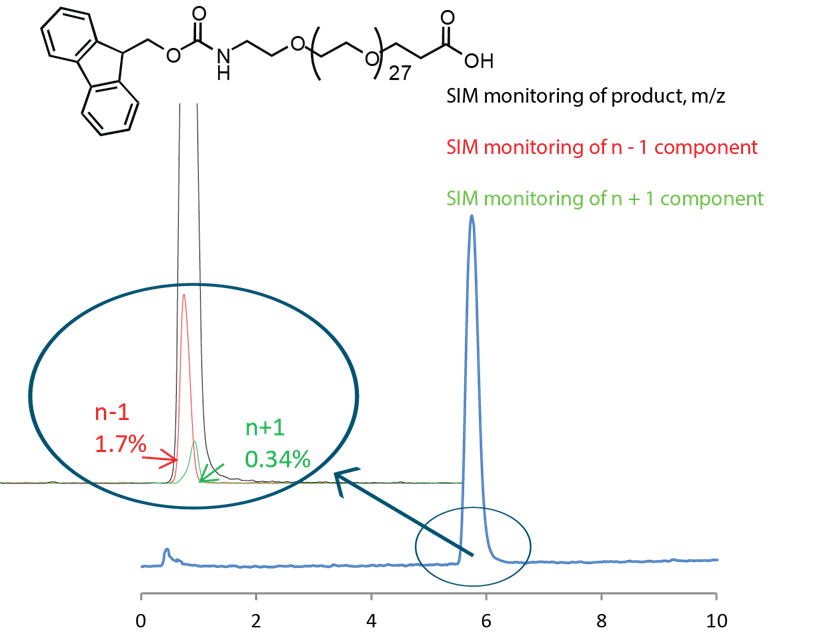
This is particularly valuable when linker length influences the accessibility of a functional group, the distance between two molecular components, or the properties of the final conjugate. Figure 1 shows the oligomer distribution in the single-length Fmoc PEG-27 acid.
Why does this matter for peptide synthesis and bioconjugation?
Peptide-based molecules present several development challenges, including poor solubility, aggregation and steric hindrance (Chen et al., 2024). PEG linkers help address some of these challenges by introducing a flexible and hydrophilic spacer. In such cases, high-purity and monodisperse PEG compounds can be of use.
Monodisperse PEGs add more control
The challenges associated with using PEG and other solubilizing modifications in peptide conjugation include difficulties in purification and analysis, steric hindrance during synthesis, and structural heterogeneity caused by the molecular-weight distribution of conventional PEGs (Liu et al., 2026).
Because the linker has a defined molecular weight and chain length, the resulting peptide conjugates have more homogeneous, predictable, and consistent pharmacokinetic profiles than conjugates produced using polydisperse PEGs with a mixture of chain lengths. This simplifies analytical characterization and support reproducibility during development and manufacturing (Kinbara, 2018). Eventually also leading to simpler regulatory characterization (Liu et al., 2026).
While monodisperse PEGs address the issues with analysis, reproducibility and structural heterogeneity, at Polypure, we developed a selection of trifunctionals that address the steric hindrance. Figure 2 shows the schematic N-PEGylated-glycine structure. The visible secondary amine NH- group is intended for protection, like Fmoc or Boc. The R group can be methoxy or another functional group compatible with peptide synthesis. Carboxylic group can be used for coupling to a linear amide bond.

Peptide-based cancer vaccines
Peptide-based cancer vaccines consist of amino acid sequences derived from tumour antigens. These sequences can be long and contain hydrophobic regions, making synthesis and purification challenging (Luna et al., 2024). Polypure supports peptide PEGylation with defined PEG chains to improve solubility and help address common synthesis, purification and downstream processing challenges associated with hydrophobic peptides.
A toolbox of defined PEG building blocks
Monodisperse PEG chemistry can be adapted for different synthesis and conjugation strategies through the selection of appropriate functional end groups.
Examples include:
- Fmoc-amino-PEG-acids – such as Fmoc-amino-PEG27-propionic acid, combining an SPPS-compatible Fmoc-protected amine with a terminal carboxylic acid for further coupling.
- Boc-amino-PEG derivatives – for introducing defined PEG spacers through orthogonal protecting-group strategies.
- Amino-PEG-carboxylic acids – versatile heterobifunctional linkers for stepwise peptide conjugation.
- Amino-PEG-amines – particularly monoprotected diamines, are useful when reactive amine groups are required at one or both ends of a defined PEG spacer.introducing defined PEG spacers with reactive amine functionality.
- mPEG derivatives – such as monodisperse mPEG45, as defined starting materials for PEGylation and further functionalization.
- N-PEGylated-glycines – offer optical purity; a trifunctional linker adds a functionality that can be incorporated within the peptide sequence chain.
By combining a monodisperse PEG length with specific terminal functionalities, these building blocks can be selected and controlled for peptide synthesis, peptide modification and bioconjugation.
References
Cen, J., Hou, M., & Liu, S. (2023). Discrete polyethylene glycol derivatives as a potent impetus for next-generation biomedicines. Giant, 15, 100169. https://doi.org/https://doi.org/10.1016/j.giant.2023.100169
Chen, X., Xia, C., Guo, P., Wang, C., Zuo, X., Jiang, Y. B., & Jiang, T. (2024). Preserving Structurally Labile Peptide Nanosheets After Molecular Functionalization of the Self‐Assembling Peptides. Angewandte Chemie, 136(2), e202315296.
Kinbara, K. (2018). Monodisperse engineered PEGs for bio-related applications. Polymer Journal, 50(8), 689–697. https://doi.org/10.1038/s41428-018-0074-2
Liu, W., Wang, X., Pai, R., Zhang, J., Tran, C., Li, L., & Jin, Z. (2026). Enhancing Peptide Hydrophilicity of SPPS-Derived Peptides Using Fmoc Noncanonical Amino Acids: A Review. ACS Biomaterials Science & Engineering, 12(4), 2079–2096. https://doi.org/10.1021/acsbiomaterials.5c02185
Luna, O. F., Perez, Y. V., Ferrari, D. P., Sayedipour, S. S., Royo, M., Acosta, G. A., Cruz, L. J., Alves, F., Agner, E., Sydnes, M. O., & Albericio, F. (2024). Impact of N‑Terminal PEGylation on Synthesis and Purification of Peptide-Based Cancer Epitopes for Pancreatic Ductal Adenocarcinoma (PDAC). ACS Omega, 9(32), 34544–34554. https://doi.org/10.1021/acsomega.4c02604
Ma, M., Di, J., Wang, C., Xie, Y., Cui, F., Zhai, Y., Zhu, S., & Gao, J. (2025). Site-specific PEGylation of proteins: Insights into structural and functional changes. Acta Pharmaceutica Sinica B, 15(12), 6253–6273. https://doi.org/10.1016/j.apsb.2025.10.014