
At Polypure we developed high-purity, monodisperse Polypropylene Glycol (PPG)
Monodisperse Polyethylene glycol (PEG) has long been widely used in nanoformulations to improve solubility and biocompatibility in pharmaceutical systems.
At the same time, monodisperse Polypropylene Glycol (PPG) is attracting increasing interest as a potential alternative material, particularly for hydrophobic drug delivery.
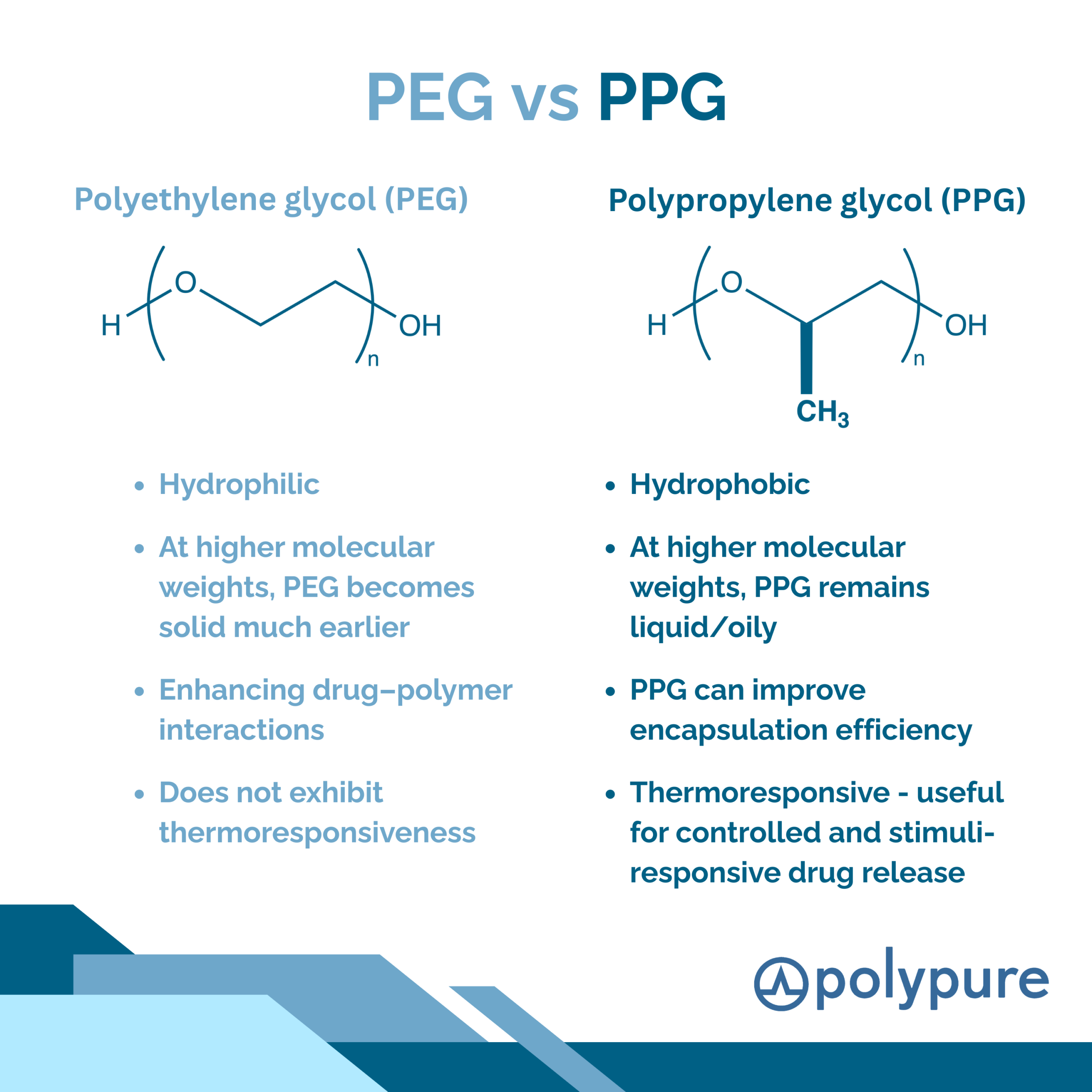
Compared with PEG, PPG’s higher hydrophobicity may improve affinity toward hydrophobic drug molecules and enhance encapsulation efficiency. In addition, PPG exhibits thermoresponsive behavior, also known as Lower Critical Solution Temperature (LCST) behavior, which may enable temperature-triggered material responses.
Why is this interesting?
PPG possesses a unique molecular duality: a hydrophilic ether group in its backbone that can form hydrogen bonds, combined with hydrophobic methyl side groups. This balance between hydrophilic and hydrophobic interactions allows PPG to respond dynamically to changes in its environment.
At certain temperatures, PPG can transition from a soluble to a phase-separated state — a hallmark of LCST behavior. Such responsiveness may support controlled drug release, self-assembly into nanostructures such as micelles and nanogels, and the development of smart responsive materials.
Molecular weight plays an important role in this behavior. Lower molecular weight PPGs have been observed to remain water-soluble while exhibiting LCST transitions in aqueous systems. In contrast, higher molecular weight variants often display LCST values below room temperature, significantly influencing their behavior and formulation potential.
Beyond water-based systems, LCST behavior has also been observed in ionic liquids, opening additional opportunities for formulation science. Recent studies have even reported unexpected co-solvency effects, where small amounts of water influence PPG solubility in ionic liquid systems and alter LCST behavior in meaningful ways.
Why is it not used now?
One of the key barriers to broader biomedical use of PPG has been material consistency. Conventional commercial PPG often contains compositional variability and unsaturated impurities, creating challenges for reproducibility in sensitive applications.
As part of an internal research initiative, Polypure has developed a high-purity, monodisperse PPG designed to address these limitations and support further research into advanced drug delivery systems.
The question now becomes: could high-purity monodisperse PPG emerge as an important next-generation material platform for nanoformulations?
DrugDelivery #Nanomedicine #PolymerScience #Biomaterial
References
Aseyev, V., Tenhu, H., & Winnik, F. M. (2010). Non-ionic thermoresponsive polymers in water. Self organized nanostructures of amphiphilic block copolymers II, 29-89.
Brewer, K., Gundsambuu, B., Facal Marina, P., Barry, S. C., & Blencowe, A. (2020). Thermoresponsive poly (ε-caprolactone)-poly (ethylene/propylene glycol) copolymers as injectable hydrogels for cell therapies. Polymers, 12(2), 367.
Herzberger, J., Niederer, K., Pohlit, H., Seiwert, J., Worm, M., Wurm, F. R., & Frey, H. (2016). Polymerization of ethylene oxide, propylene oxide, and other alkylene oxides: synthesis, novel polymer architectures, and bioconjugation. Chemical reviews, 116(4), 2170-2243.
Kodama, K., Tsuda, R., Niitsuma, K., Tamura, T., Ueki, T., Kokubo, H., & Watanabe, M. (2011). Structural effects of polyethers and ionic liquids in their binary mixtures on lower critical solution temperature liquid-liquid phase separation. Polymer journal, 43(3), 242-248.